
Grounded perspective
Rational
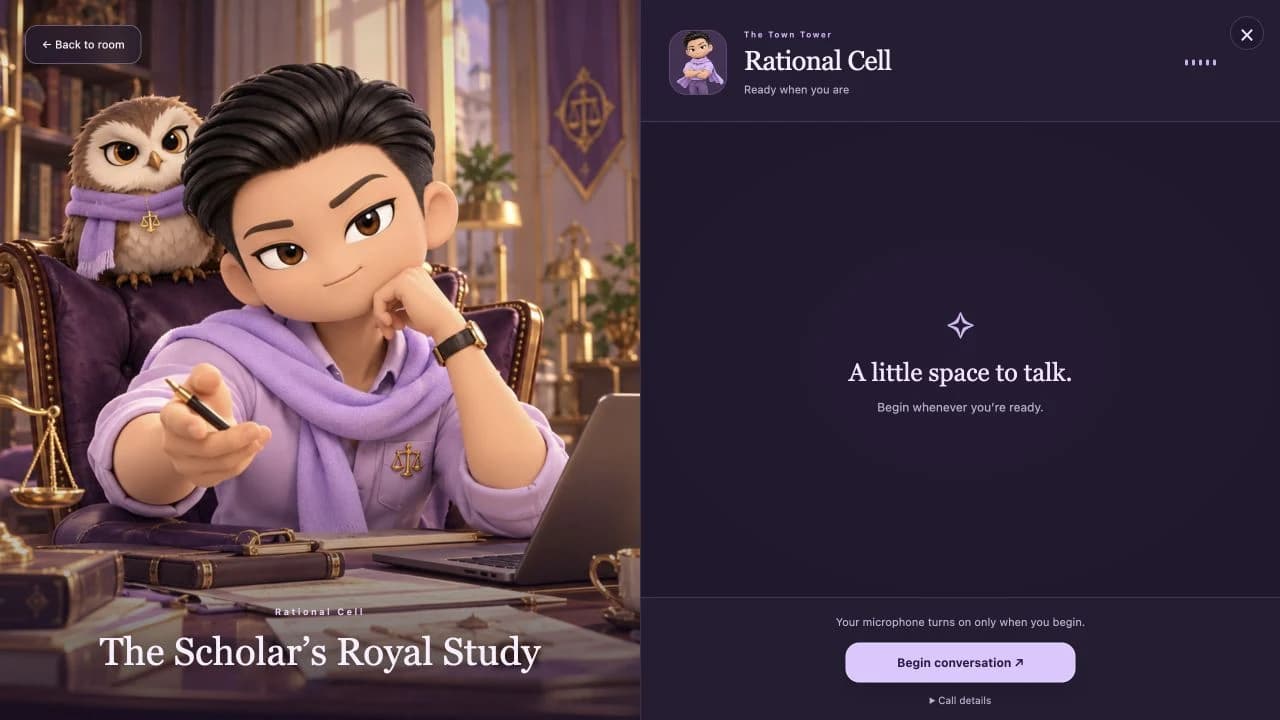
Calm, thoughtful, and gently blunt. Helps separate feelings, evidence, and possible next steps.

An inner world you can explore—and talk to.
Cell Village turns different sides of my inner world into AI characters with their own voices, personalities, and homes. Explore the village, visit a cell, and start a conversation—from Rational’s grounded perspective to Delulu’s extravagant optimism.
Overview / Independent project
Inspired by the personified inner world of Yumi’s Cells, I imagined my own village of competing perspectives: the part that reasons, the part that dreams, and the part that investigates everything. I created an original cast and explored how each perspective could become a distinct conversational experience.
How could a character’s appearance, surroundings, voice, and responses feel like parts of the same personality?
See the experience ↓01 / The experience
Each building leads to a character’s room. From there, visitors can learn about the cell or begin a voice conversation. A split view keeps the character’s world on the left and the conversation transcript on the right.
A recording of the working flow is next: village → Rational’s room → begin → actual exchange → end call.
02 / Building the world
I developed a shared visual identity around rounded silhouettes, lilac clothing, and expressive faces. Hair, accessories, posture, and personal spaces distinguish each cell while keeping the cast recognizably part of one world.
Try a character · Introductions without recordings use a 10-second silent preview.
Character designs · Ten original characters; Rational, Delulu, and deTECHtive have connected agents.
Their homes extend their personalities. I used AI image generation to explore these designs, then selected and refined the direction across the cast.
Grounded perspective
Calm, thoughtful, and gently blunt. Helps separate feelings, evidence, and possible next steps.

Imaginative encouragement
Sassy, dramatic, and optimistic. Makes space for ambitious possibilities without claiming she can predict the future.


Career investigation
Sharp, skeptical, and evidence-led. Examines role expectations and career fit, and names what she cannot verify.

03 / Designing conversations
I defined more than a tone of voice for each cell. Their instructions describe what they notice, how they respond, when they ask questions, and when they should stop trying to solve the problem.
Across all three, I aimed for short responses—one or two sentences—and an explicit respect for requests such as “please don’t give me advice.”
“I found my dream AI role, but I’m not sure I’m good enough. What do you think?”
Rational
Separate feelings, evidence, and possible next steps without taking over the decision.
Delulu
Make space for ambitious possibilities while keeping imagination distinct from prediction.
deTECHtive
Examine role expectations and career fit. Name what cannot be verified with the available information.
Behavior directions, not agent replies. Actual audio and transcripts from the same-prompt test are still to be recorded.
04 / Testing & iteration
I tested the pilot agents by speaking naturally: changing my mind, correcting their interpretation, hesitating, and asking them to listen without offering advice. These exchanges exposed gaps that a character description alone did not catch.
“What’s the smallest first move you could make on one of them?”
Earlier in the same test, I had asked for no advice.
“Okay, the imaginary confetti is back in the drawer.”
I had asked to vent rather than receive advice.
“That’s not an answer, babe. Python and PyTorch, any real work with them, or not?”
I had hesitated and said “okay.”
In another test, deTECHtive correctly said she could not open websites in the current setup. Research tools are planned; she should not imply that she has verified a source without them.
05 / Bringing it to life
The early room experience presented too much character information before the visitor could act. I simplified it to two choices: talk to the cell or get to know them. Detailed profiles remain available on request, while the main path leads directly into the conversation.
I also made the buildings clickable beyond their numbered markers and kept hover labels stationary. The goal was to make exploration feel direct, without asking visitors to chase small or moving targets.


Current interface captures · The earlier information-heavy room is described above, not recreated as a “before” screenshot.
Creative direction + implementation
I led the concept, character definitions, visual direction, dialogue examples, and interaction decisions. I used AI tools to generate visual assets and assist implementation, then reviewed the results and iterated on the experience.
01 / Design record
“Combine feelings, evidence, and personal values into a small set of options. Help Shiyaa choose; do not choose for her.”
Character bible, v1.1
02 / Visual direction
Selected character and room artwork.
03 / Agent instruction
“These examples establish your style. Adapt to the current conversation rather than repeating them as catchphrases.”
Rational’s authored system prompt.
04 / Working interface
Current ready state, not a simulated call.
The current prototype connects Rational, Delulu, and deTECHtive to their configured ElevenLabs Agents. Their responses appear alongside the conversation, with controls to begin, mute, and end a call.
Selected character and call controls
Issues temporary access; keeps the API key private
Voice and transcript events connect to the browser
06 / What’s next
The prototype includes ten original characters and their rooms, an interactive village, and three connected voice agents. It is currently a personal local prototype; broader usability testing and a public demo are still ahead.
The most useful lesson so far is that personality lives in small conversational choices: whether a character waits, asks another question, admits uncertainty, or turns listening into advice. Testing those moments gave me more useful direction than adding more personality adjectives.
Next, I want to test the revised behaviors across repeated conversations, connect inspectable memory through Make and Airtable, and explore how several cells could contribute without overwhelming the person speaking.