A conversation leaves a trace.
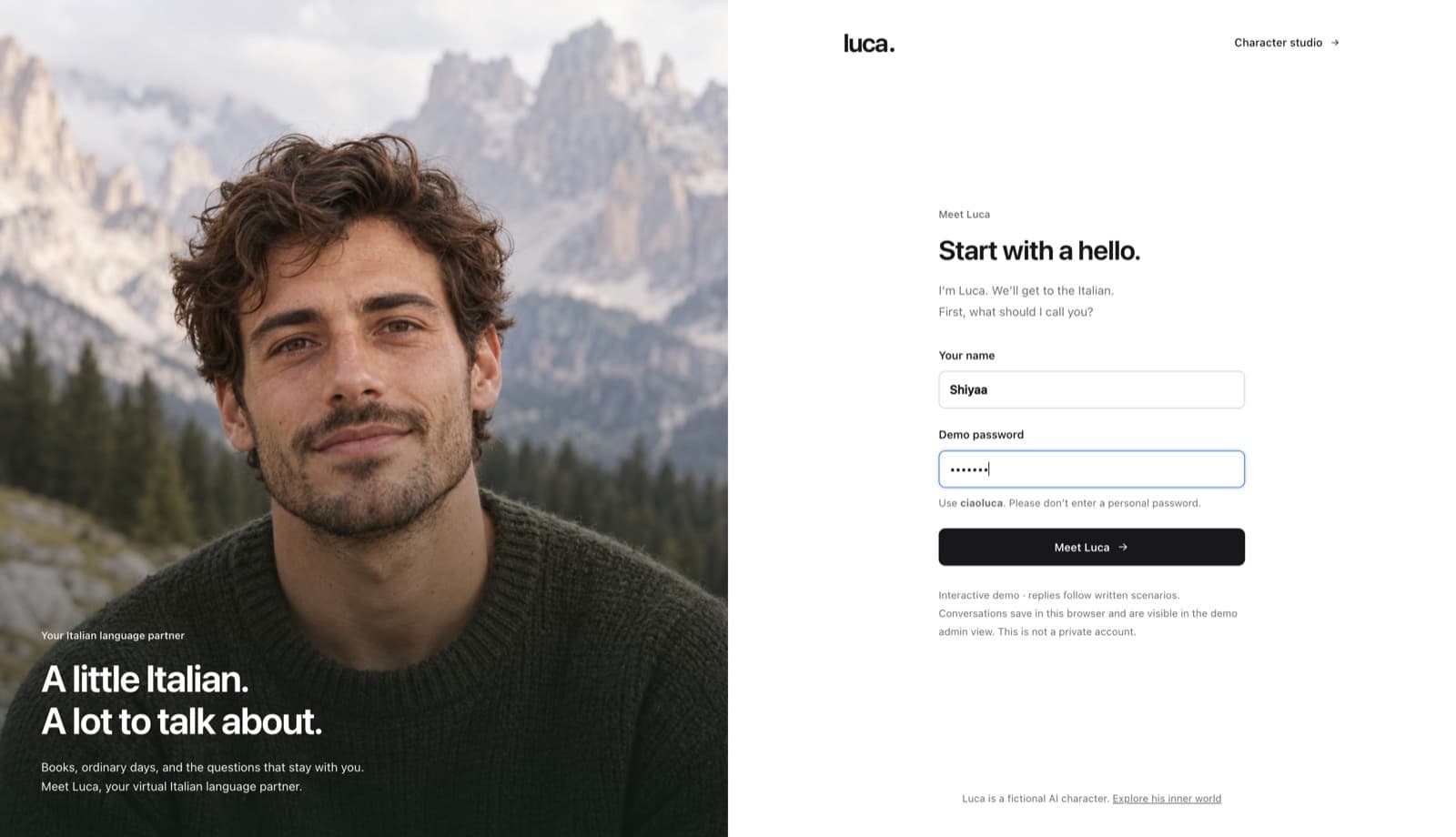
Meet Luca. A voice-based AI companion you get to know through Italian, books, and the conversations you come back to.
- My focus
- Character, conversation & experience design
- The medium
- Voice, memory & writing
- The question
- What makes a conversation worth returning to?
The short story / TL;DR
Something to pick up next time.
Luca is a fictional character with a point of view. A conversation can shape what he writes afterward; that writing can open a new thread when you return. I’m exploring how personality, remembered context, and voice could make those moments feel connected.
An evolving concept study. Dialogue and design details below are illustrative; the connected experience is yet to be prototyped and tested.
What if the most interesting part of a conversation happened after you said goodbye?
01 / The experience
One disagreement. Three connected moments.
Follow a disagreement through tonight’s conversation, a written reflection, and the next encounter. Then explore how a reviewed change to Luca’s perspective could coexist with separate personal memories.
Interactive concept · Scripted dialogue, with no live AI or voice.
Open the demo in a new tab ↗02 / Character & conversation
A point of view, with room to move.
A character becomes recognisable through choices. These draft principles explore how Luca’s tastes, contradictions, and curiosity could shape what he says.
“I can agree with your conclusion and still want to argue with how you got there.”Luca / a voice in development
Conviction without stubbornness
He offers a reason for his position. A convincing argument can change a part of it, and he can explain which part.
Curiosity without interrogation
He follows an interesting thread, offers a thought of his own, and leaves room for you to take the conversation elsewhere.
A contradiction worth exploring
He values independence, yet loves the familiarity of returning to the same books and conversations. That tension gives his writing somewhere to go.
03 / Designing continuity
Remember the thread. Leave room for change.
The design question is what deserves to carry forward. A useful memory should preserve the context of an idea while allowing you to correct it, leave it behind, or begin again.
- 01
A conversation
A viewpoint, a preference, an unresolved question.
- 02
A selected trace
Relevant context you can inspect, correct, or remove.
- 03
A written reflection
A generated passage shaped by context and character.
- 04
An invitation
A possible opening for the next conversation.
Memory should be revisable
“You thought this then” leaves more room than “You always think this.” Preferences and opinions can change.
Initiative should have boundaries
Choose whether Luca can follow up, which topics he can revisit, and when you’d rather leave a conversation where it is.
Writing should have a source
A reflection connects to a prior exchange or an established character interest. It doesn’t imply a continuously thinking mind.
04 / Italian through companionship
Stay with the thought. Find the words together.
Italian practice grows out of something you actually want to say. The aim is to help at the point of need while preserving the rhythm of the conversation.
A moment of language support / illustrative
Volevo dire… she took him for granted. Come si dice?
“Lo dava per scontato.” E secondo te, quando se n’è accorta?
“She took him for granted.” And when do you think she realised it?
Two proposed ways to practise
Keep the flow
Offer help when asked; save optional language notes for afterward.
Help as we go
Offer brief corrections when they help express the thought, with space to continue.
05 / What the prototype needs to prove
The idea is connection. The test is whether you feel it.
The next step is a small, connected prototype: a voice conversation, a reflection, and a return visit. These are proposed evaluation questions, not research findings.
- 01
Does he feel like the same character?
Compare exchanges across sessions. Look for consistent values, natural phrasing, and reasons behind changes of mind.
- 02
Does the reflection add something?
Ask readers what the writing develops beyond a recap, and whether it gives them a reason to return.
- 03
Does remembering feel appropriate?
Try relevant, outdated, and corrected memories. Check whether people understand and can change what carries forward.
- 04
Does Italian support preserve the moment?
Compare when help is offered. Look for moments where it builds confidence or interrupts the thought.
For me, the interesting challenge is making voice, writing, and remembered context feel like parts of the same character. That connection is what I want to build and test next.